
Dog training in Roseville, CA
Reactive dog training in Roseville: calmer walks on the busy trails you actually use.
Roseville has more trail miles than any of the surrounding cities, and that is a real advantage for training. Paved paths, oak woodland, open grassland, and wetland all sit inside one connected system, which means there is always somewhere to work. The thing worth building is a dog you can take anywhere in it.
The same trails carry everyone else, though. Cyclists, runners, strollers, and other dogs share the same path, and the busiest stretches leave you nowhere to step aside. That is not a flaw in the city, it is just what a popular multi-use trail looks like, and it means your dog has to be ready for company.
Sessions build toward passing close, handling movement from behind, and staying functional on a busy trail instead of turning around at the trailhead. That is the difference between a dog you manage and a dog you enjoy.
Prefer to talk first? Call or text 916-232-9185
Sound familiar?
Roseville has the best trail system around. If you are reading this, you are probably driving somewhere else to walk.
There is a stretch of trail you skip now. There is a cyclist who comes up behind you without a sound, and you have started turning around before the trailhead. The trail you moved close to is the one you do not use.
You have not done anything wrong. It is a pattern, and it shows up on these trails so often that I can usually guess which one you use.
What changes, and when
Many dogs show real change by the fourth lesson. The six weeks matter because the last stretch is where it starts to hold on a crowded trail, not just an empty one. It can be extended if your dog needs more time.
Start with the free evaluation.
Book my free evaluationRoseville, California
A connected trail system, and a dog who has to be ready for company
Multi-use trails for everyone
Roseville has a huge number of trails, and they are multi-use, with dogs as well as bikes and runners at speed. Approaching from behind, a cyclist is silent until they are close, which startles even dogs who handle other dogs well. That is a skill worth practicing, and Roseville's trails are the perfect place to practice, once the dog is ready.
Crossing trails that carry everyone at once
The system is connected rather than linear. Trailheads, crossings, and junctions do not separate dog walkers from commuters, so the easy separation of a quiet neighborhood street is not there when you need it. Learning to work without that buffer is part of the job.
Off-leash areas adjacent to on-leash trails
Several stretches put leashed dogs next to off-leash ones with little buffer. An on-leash dog meeting an off-leash dog is the most common trigger for a serious reaction, and it is completely predictable in these spots. That predictability is useful, because we can set up and rehearse the pass instead of being surprised by it.
Distance and duration
Longer trails mean longer exposure, which is a chance to build real endurance. A dog who holds it together for ten minutes near home may be out of capacity two miles into a busy trail. That is exactly the gap worth closing, because technique alone will not carry a dog through a long walk.
Where the work happens
The kinds of ground the work happens on
These are the situations that come up most often in evaluations here. All of them are training ground, and most of them are good at it.
The paved multi-use trail network
Miles of paved trail running through oak woodland, grassland, and wetland, all connected. It is consistently busy, so it is also where most owners here first see the full version of their dog's reaction. We can use that.
Parks with off-leash areas attached
One end of the trail system connects to a park with an off-leash area, putting leashed and unleashed dogs in the same vicinity. The approach is always the same: work the outside, where we are safe and the distraction is still real.
Greenbelt connectors behind Roseville neighborhoods
The smaller residential paths linking developments to the main network. Narrow, shaded, and short on sightlines, so encounters arrive with little warning. This is where your own neighborhood becomes useful, because your dog knows it and you can step out the door and train.
Trailheads and road crossings
Where the trail meets a street or a parking area. Traffic, waiting dogs, and confined space all at once. Not the first lesson, but a good test of whether the earlier work is holding.
Busy commercial corridors and parking lots
Daily errands put dogs near traffic, carts, and strangers. Dogs who react to loud noises or fast movement often show it here first, long before it shows up on a quiet walk, which makes a routine errand one of the most useful training sessions you can get.
Inside a session
How the hour actually runs
In Roseville, we often finish by working past a trail entrance where the traffic is steady.
First
We talk about your week
What went well, what did not, and where to aim the hour.
Then
We warm up on the basics
Start with what your dog knows, get them thinking, add the next skill.
Next
We add more going on
Heavier distraction, and a controlled look at a real trigger.
Last
We end calm
Your dog practices relaxing before we finish, every session.
Not sure where your dog fits?
Forty-five minutes is usually enough. Most owners know whether this is worth pursuing before they leave.
From clients
What owners say
Collected over several years of working with local families. Program details have been updated since some were written.
"Derek worked with us and our 1 year old Catahoula, Harvey, to help with reactivity and recall. Harvey is a great dog but young and easily distracted. Derek was great in breaking down the training and getting Harvey motivated and learning. He came along really quickly and is doing great now. We highly recommend Derek's approach."
"Our 1-year-old lab mix has a lot of energy and Derek's training style fit perfectly. The method of learning through play kept our dog's attention, while also making it a fun experience. His training expectations were realistic and he always gave us something new to focus on each week between our lessons."
Questions
The questions Roseville owners ask first.
Still deciding?
The free evaluation is where most of these get answered for your dog, not in general.
Book my free evaluation01Do you work with dogs on the main trail system?
Yes. The trail is the environment most Roseville owners need to function in, so we build up to it and then work on it. That means starting somewhere quieter to establish the skill, then taking it to the real trail traffic once your dog has something to fall back on.
02My dog reacts to bikes and runners, not just other dogs. Is that covered?
Yes, and Roseville is one of the few places where that is nearly universal, because the trails are genuinely multi-use. Movement triggers get treated as their own problem rather than folded into the general reactivity work.
03Can we still use the trails while we train, or do we have to avoid them?
You can keep walking. Complete avoidance usually makes the problem worse over time because the dog never gets to practice a better choice. We manage distance and timing at first, then reduce those supports deliberately as your dog is ready.
04What does it cost?
The evaluation is free. E.D.G.E. is $2,397 for 6 one-on-one sessions across 6 weeks, with equipment, online classroom access, and six months of support plus three follow-up lessons included and no travel fee inside Placer County. The program can be extended if your dog needs more time, and the Make-Right Guarantee covers up to 10 lessons total. Basics is $997 for 4 one-on-one lessons for everyday leash skills, with equipment, online classroom access, and six months of support included.
05How long does the program take?
6 weeks, extendable if your dog needs more time. Many dogs show real change by the fourth lesson, and the full program is what makes it hold.
Keep exploring
A clear first step
Let's make the trail an easy place to be.
The evaluation is held in Rocklin at Johnson-Springview Park. It covers your dog, your goals, and the Roseville routes you use most. You leave with a clear plan for your dog, whether or not you train with me.
What to know before you book
- Cost
- Free, with no deposit
- Length
- 45 minutes
- Where
- Johnson-Springview Park, Rocklin, by the baseball diamonds. Lessons after that come to your neighborhood.
- Bring
- Your dog on their usual collar and leash, plus treats your dog loves
- Records
- Proof of current vaccinations, or a titer test done within the last 30 days
- One limit
- I can't take dogs with a documented bite history (insurance)
- Programs
- Basics $997 · E.D.G.E. $2,397 · Aggression from $3,600
- You leave with
- An honest read on your dog and a recommended next step
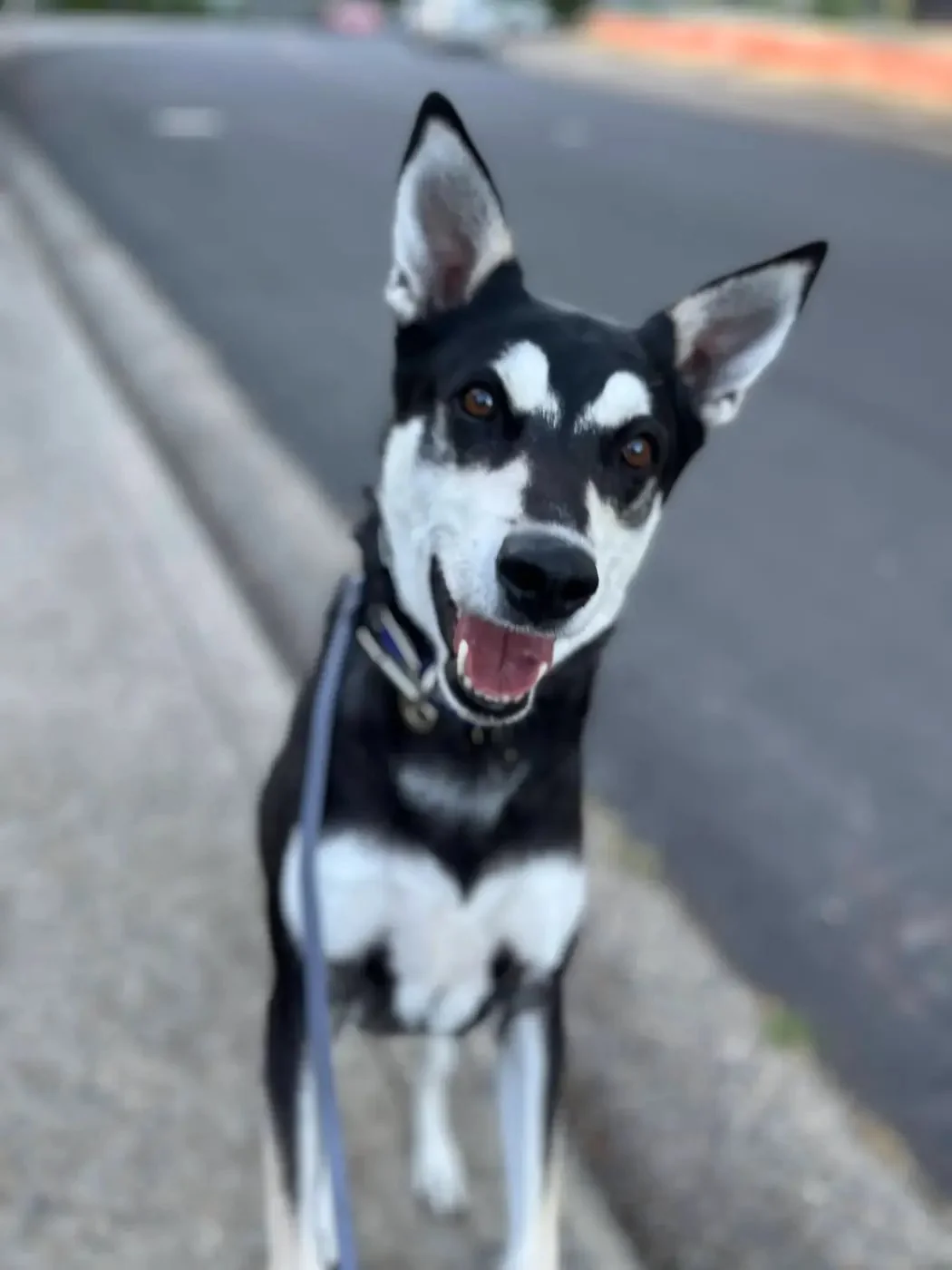
Make-Right Guarantee
The Make-Right Guarantee: if we have not hit your goals after the 6 sessions of E.D.G.E., you get up to 4 additional lessons at no cost, bringing it to 10 lessons. At least one of those is mine alone, with no leash in your hand.
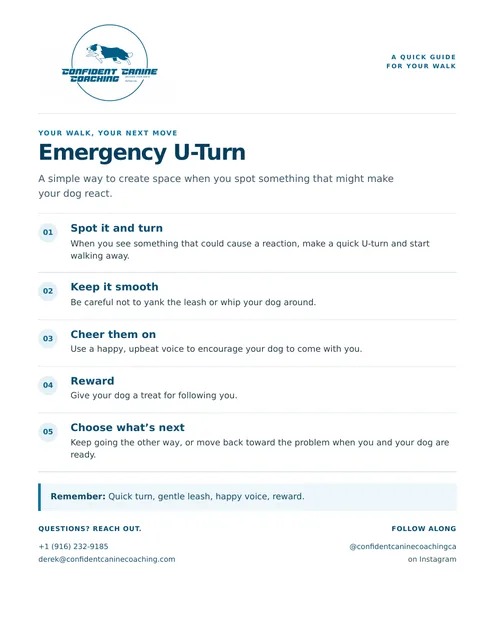
Free one-page cheat sheet
Not ready to book? Start here.
Get the Emergency U-Turn Cheat Sheet: a simple way to create space on a walk when you spot something that might make your dog react.