
Service area
Leash reactivity coaching across Placer County.
Confident Canine Coaching works with adult dogs and their people across Placer County, including Rocklin, Roseville, Loomis, Lincoln, and Granite Bay. Sessions happen where the behavior actually shows up: your neighborhood, your street, your driveway, and the routes you walk every day.
Placer County is a good place to train a dog. It is suburb rather than city, so there are parks, greenbelts, open fields, and trail systems all over, and people here take their dogs out. That adds up to an enormous amount of opportunity, and it is what makes a dog who can go anywhere possible.
There is no facility to drive to, and that is deliberate. A dog who holds it together in a training building has not necessarily learned anything about your street at 6pm when three other dogs are out.
Prefer to talk first? Call or text 916-232-9185
Sound familiar?
Placer County gives you more training ground than almost anywhere. If you are reading this, you are probably using a fraction of it.
There is a route you have quietly retired. There is a park you drive past on the way to somewhere quieter. Most owners in this county are not short on places to walk. They are short on places their dog can handle.
None of that is a failure on your part. It is the same pattern I run into all over this county, and it is the one I work on every week.
What changes, and when
Many dogs show real change by the fourth lesson. The program runs six weeks because the last stretch is what makes it hold when the trail is busy and the parking lot is full, and it can be extended if your dog needs more time.
It starts with a free evaluation.
Book my free evaluationTown by town
Five towns, five different sets of triggers
Placer County is not one place with one dog problem. A greenbelt in Rocklin and a horse property in Loomis ask for different things, and the county line is not what changes. This is what I see in each town, and what it means for the work.
| Town | What it is like | What your dog will run into |
|---|---|---|
| Rocklin | Suburb with real open space, and a community that uses it. Parks and fields are one of the best things about living here. | Narrow greenbelts with blind corners, heavy squirrel and turkey traffic, and other people in the good spots because they had the same idea. |
| Roseville | The busiest and most built up of the group, with the widest trail network and the most foot traffic on it. | Multi-use trails with bikes and runners passing at speed, plus the volume of dogs that comes with this many households. |
| Lincoln | Still growing, with a trail system tying the whole town together and a rural edge that starts quickly. | New neighborhoods full of new dogs, a busy off-leash park, and horse properties once you get past the subdivisions. |
| Loomis | A real town with a rural character, and the most open ground of anywhere I work. | Horses on the roads and trails, livestock behind fences, and rural roads with no sidewalk when something is coming. |
| Granite Bay | Large lots, oak woodland, and quiet streets where the neighbors are spread out. | Fewer dogs per street, which cuts both ways, plus deer and other wildlife that show up without warning. |
Read down the column on the right and the pattern is hard to miss. Most of these towns share the same core problem, which is narrow ground with nowhere to step, and the others replace it with open ground and horses. That is the whole reason this work happens in your neighborhood instead of a training room.
Placer County, California
Three kinds of ground, grouped by what they teach your dog
Rather than a list of addresses, here is how I think about the county's training ground. Everything below falls into one of three groups, and the group tells you what the session is for.
Group one
Tight ground, where there is nowhere to step
Greenbelt paths threading behind houses and between neighborhoods. Narrow, shaded, with a fence or a slope on one side, so when another dog appears the only option is handling. This is where we practice calmly walking past another dog up close, and it is the skill most owners are missing.
- Greenbelt paths threading behind neighborhoods
- Narrow stretches of the paved trail network
- Historic downtown sidewalks on a hillside
Group two
Fast ground, where things come at you
The paved multi-use trails, full of bikes, runners, and strollers alongside plenty of other dogs. Movement at speed is its own skill, and it is separate from the dog-to-dog work most owners assume is the whole problem. Being surprised from behind is the part that catches dogs out.
- Paved multi-use trails, miles of them, all connected
- Park trailheads where the paths and the roads meet
- Town-wide trail and bikeway systems
Group three
High-distraction ground, used from the outside
Places where a lot of dogs and excitement get concentrated into one spot. Dog parks aren't the right fit for most reactive dogs, but from outside the fence they're great training ground, as long as we stay on our side of it. The excitement is real and the risk is not.
- Off-leash parks, worked from outside the fence
- Busy trailheads on a weekend morning
- Waterfront parking areas in summer
Your own street belongs in the first group, and it is usually the most useful ground you have, because your dog knows it and you can start the moment you step outside.
Inside a session
How the hour actually runs
Across the county, the walking conditions change from town to town and the session adjusts with them.
First
We talk about your week
What went well, what did not, and where to aim the hour.
Then
We warm up on the basics
Start with what your dog knows, get them thinking, add the next skill.
Next
We add more going on
Heavier distraction, and a controlled look at a real trigger.
Last
We end calm
Your dog practices relaxing before we finish, every session.
Not sure where your dog fits?
Forty-five minutes is usually enough. Most owners know whether this is worth pursuing before they leave.
From clients
What owners say
Collected over several years of working with local families. Program details have been updated since some were written.
"Once Derek showed me how to communicate clearly and consistently, everything changed. My dog now listens, he checks in with me, he's calmer, more focused, and so much less reactive. For the first time, I can take him on a walk without feeling anxious the entire time. Derek is a wonderful trainer."
"You can tell he has a passion for what he does and truly cares about each dog family that he helps. His techniques help you and your dog create a unique bond that encourages your pup to not just follow your lead, but to want to follow your lead."
Questions
What people ask before they book.
Still deciding?
The free evaluation is where most of these get answered for your dog, not in general.
Book my free evaluation01Which cities do you cover?
Rocklin, Roseville, Loomis, Lincoln, and Granite Bay, plus the surrounding Placer County neighborhoods. If you are near the edge of that area, call or text and ask. The honest answer is better than guessing.
02Do you travel to my neighborhood?
Yes. Training happens in your neighborhood and the routes you actually walk, because that is where the behavior has to hold. Your dog's problem does not live in a training room, so driving to one would not solve it.
03Do you work with dogs from any breed?
Yes. Herding and working breeds often move faster because they are quick to learn and eager for a job, but the program adapts to a wide range of breeds and temperaments. The evaluation tells us both whether this is the right fit.
04What if I am not sure my dog is reactive enough to need this?
E.D.G.E. is built for moderate to severe reactivity. Milder? The evaluation will tell you if Basics is enough. If walks make you tense, if you are planning your route around other dogs, or if you have said some version of he is fine, he just does not like other dogs, it is worth booking. Earlier is easier to change than later.
05What does the program cost?
$2,397 for 6 one-on-one sessions over 6 weeks, including equipment, online classroom access, and six months of support plus three follow-up lessons, with no travel fee anywhere in Placer County. The program can be extended if your dog needs more time, and the Make-Right Guarantee covers up to 10 lessons total. The evaluation is free. Basics is $997 for 4 one-on-one lessons for everyday leash skills, with equipment, online classroom access, and six months of support included.
06How long does the program take?
6 weeks, and we extend it if your dog needs more time. The evaluation tells us what your dog needs, and many dogs show real change by the fourth lesson.
Keep exploring
A clear first step
Let's make every route you walk an easy one.
The evaluation is held in Rocklin at Johnson-Springview Park. We look at your dog, your goals, and the routes you walk. You leave with a clear plan for your dog, whether or not you train with me.
What to know before you book
- Cost
- Free, with no deposit
- Length
- 45 minutes
- Where
- Johnson-Springview Park, Rocklin, by the baseball diamonds. Lessons after that come to your neighborhood.
- Bring
- Your dog on their usual collar and leash, plus treats your dog loves
- Records
- Proof of current vaccinations, or a titer test done within the last 30 days
- One limit
- I can't take dogs with a documented bite history (insurance)
- Programs
- Basics $997 · E.D.G.E. $2,397 · Aggression from $3,600
- You leave with
- An honest read on your dog and a recommended next step
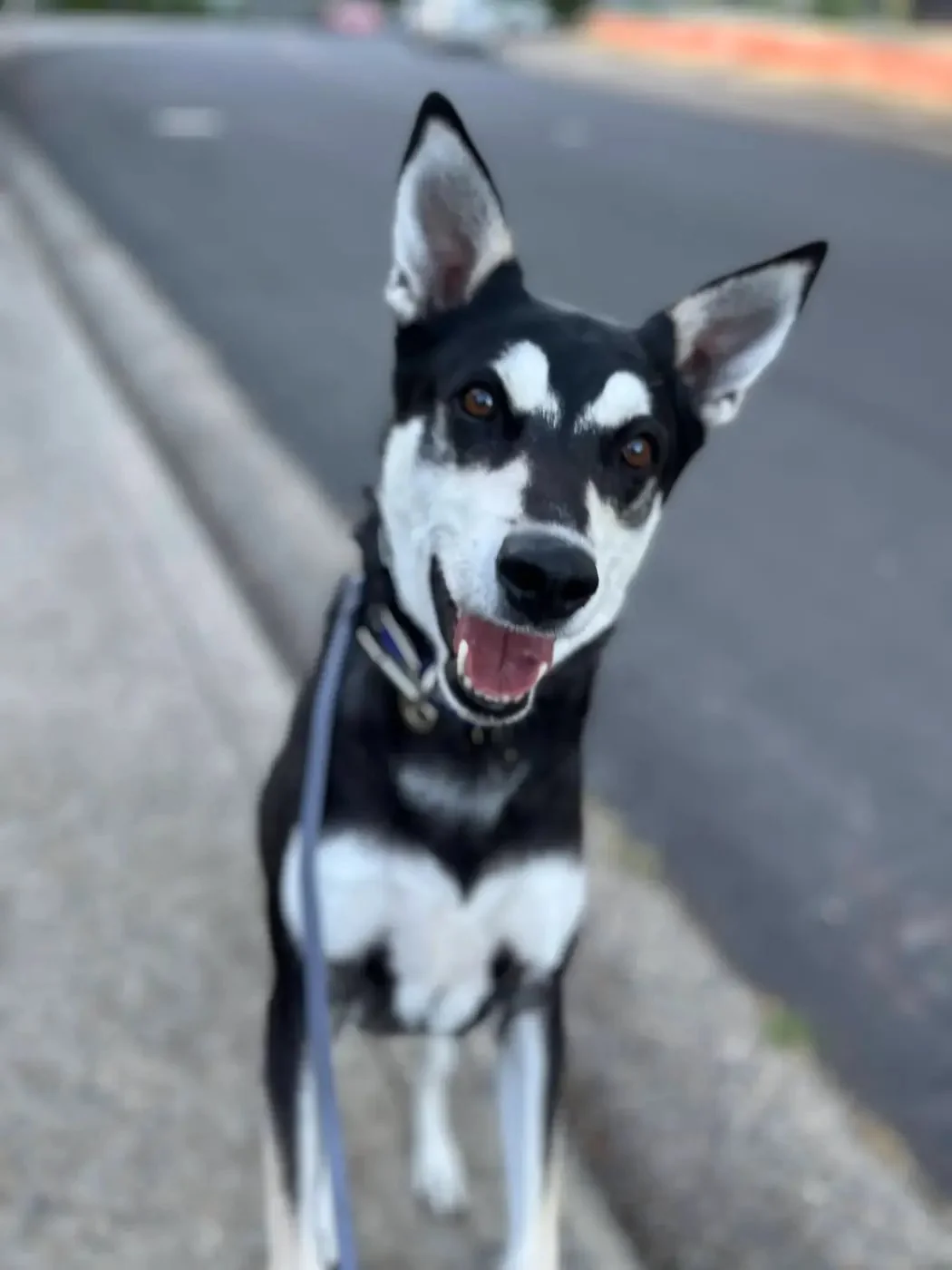
Make-Right Guarantee
The Make-Right Guarantee: if we have not hit your goals after the 6 sessions of E.D.G.E., you get up to 4 additional lessons at no cost, bringing it to 10 lessons. At least one of those is mine alone, with no leash in your hand.
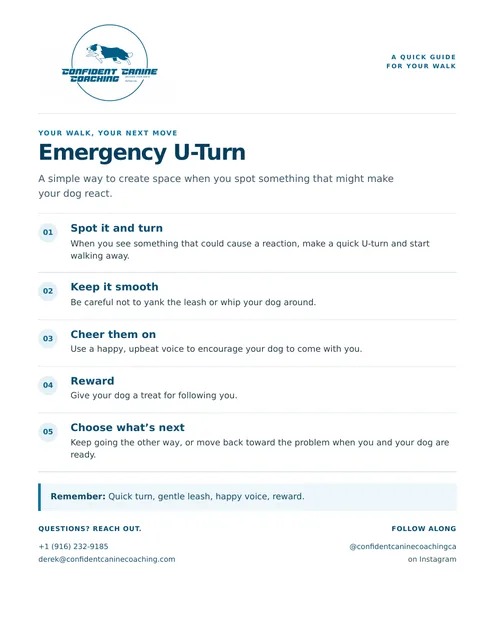
Free one-page cheat sheet
Not ready to book? Start here.
Get the Emergency U-Turn Cheat Sheet: a simple way to create space on a walk when you spot something that might make your dog react.