
Dog training in Loomis, CA
Reactive dog training in Loomis, CA
Calmer walks on the streets you actually use. Private coaching, and you hold the leash the whole way.
Loomis is one of the better places in Placer County to own a dog, and most of that comes down to space: open fields, orchards, and quiet roads that city owners have to drive to find. That space is a real advantage, and it only pays off if your dog can handle what comes with it.
That space comes with its own set of firsts. Loomis is horse country, with working properties, livestock, and equestrian trails running through it. For a dog who has never met a horse up close, that is a big one, and plenty of owners find out about it on a walk nobody planned for.
None of that is a reason to stay home. It is practice, and it is what turns a dog who manages a quiet street into the companion you can take anywhere.
Prefer to talk first? Call or text 916-232-9185
Sound familiar?
Loomis gives you space most owners would envy. If you're here, your dog may be making that space hard to enjoy.
There is a road you walk that has no shoulder, and a property with horses you cross the street to avoid. Your own land is the one place your dog is genuinely calm, and that has started to feel like the only place.
You didn't cause this. I see it every week.
What changes, and when
Most dogs I work with improve noticeably within 6 weeks. The six weeks matter because the last stretch is where it starts to hold out on the open roads and when the horses are out. It can be extended if your dog needs more time.
The evaluation is free, and it comes first.
Book my free evaluationLoomis, California
What your dog will actually meet out here
Most towns ask a reactive dog to handle other dogs. Loomis asks for more than that, and the extra is the part that makes it useful ground. Here is what tends to come up, roughly in the order owners run into it.
Horses
The one that catches owners out
Loomis is horse country. Working properties, equestrian trails, and horses moving along the roads are ordinary here rather than a special event. A horse is a large animal that moves unpredictably and does not read like a dog, and a dog who loses it over one is working on the same underlying problem as a dog who loses it over another dog. Most owners have never trained for this, because they never had to before they lived here.
Livestock
A boundary issue more than a training one
There are properties around town keeping animals, and a dog who charges a fence line is a real problem here in a way it is not in a subdivision. It is also not a dog problem in the way owners expect. This is about teaching your dog that the fence is a boundary, not a suggestion, and that holds whether there is anything on the other side or not.
Wildlife
Squirrels count, even though they do not look like it
Orchards, ponds, and open ground bring in squirrels, birds, and everything else. A dog blowing up at a squirrel does not look like leash reactivity, and most owners do not connect the two. For the vast majority of dogs they are closely related, and a rehearsed blow up makes the next one both more likely and worse. It is also the easiest version of the problem to find on purpose when no other dogs are around.
Roads
No sidewalk, no shoulder, nowhere to step
Many Loomis roads run without sidewalks, which removes the one move most owners rely on when something is coming: step aside and let it pass. Take that away and you are managing a car, a cyclist, or another dog with nothing but timing and your own handling. It is uncomfortable at first, and it is the most useful thing we practice here, because it is the situation you are already in every day.
Where the work happens
Five kinds of ground, and what each one teaches your dog
This is the ground that comes up most often in evaluations here. None of it is a place to avoid. Each one is working on something specific, which is the only reason to choose it.
The town park and its walking loop
A walking loop through open ground and wildlife habitat, with dogs welcome on leash. This is the friendliest ground in town, and that is exactly what it is for. We use it to build a foundation, then deliberately leave it, because a dog who is only reliable in the easy place has not been tested by anything that matters.
The equestrian corridors
The staging areas keep bridle paths, water for horses, and multipurpose trails that hikers and families use too. Horses also use the roads, which is the part that matters most, because that is where you meet one without warning. We treat horse work as its own skill rather than assuming dog experience carries over.
Your own road
The road you live on is the hardest and most valuable ground you have. No sidewalk means no stepping off when a car, a cyclist, or another dog comes by, so everything depends on timing and handling. It is also where your dog has the most history, which cuts both ways: the reactions tend to be sharper here, and so does the progress once it starts holding.
The creek corridors and ponds
Where dogs here get out, and they bring the wildlife that comes with this much open ground. Squirrels, birds, and everything else are constant, which makes these great practice at staying calm when something exciting moves when no other dogs are around. That happens less often than you would think.
Your own property, and the fence line around it
Most reactivity is worse in the place you walk every day, and for a lot of Loomis owners that is their own land. Your dog sees it as theirs, with familiarity and history attached. It is also the best place to start, because you can work without loading up the car, and it is where the fence line gets taught as a boundary rather than a suggestion. The limit is that a dog who is perfect at home has not met the neighbor's dog coming up the road, so we do not stay there.
Inside a session
How the hour actually runs
In Loomis, that often means your own road or a stretch where horses pass.
First
We talk about your week
What went well, what did not, and where to aim the hour.
Then
We warm up on the basics
Start with what your dog knows, get them thinking, add the next skill.
Next
We add more going on
Heavier distraction, and a controlled look at a real trigger.
Last
We end calm
Your dog practices relaxing before we finish, every session.
Not sure where your dog fits?
Forty-five minutes is usually enough. Most owners know whether this is worth pursuing before they leave.
From clients
What owners say
Collected over several years of working with local families. Program details have been updated since some were written.
"We had the pleasure of working with Derek when our dog Peyton was having fence aggression issues at our new house. He came to our house for all the visits and worked with Peyton on her fence issues as well as her separation anxiety."
"Thank you so much, Derek, for seeing our pup for who she is and working with her where she was at. Thank you for helping us to deepen our bond and to have a shared language that creates boundaries, trust, and positive results."
Questions
What Loomis owners want to know first.
Still deciding?
The free evaluation is where most of these get answered for your dog, not in general.
Book my free evaluation01Do you train in Loomis neighborhoods and parks?
Yes. Sessions happen on the routes you actually walk, which in Loomis usually means your own road, the park you use, and the quiet stretches nearby. Working where the behavior happens is the point, because a dog who only holds it together in an open field has not learned the thing you need.
02My dog goes crazy around horses. Can you help with that?
Yes, and Loomis is one of the few places where that comes up often enough to plan for. Reactivity is reactivity, with the same causes underneath, depending on the dog. A horse is a larger and less predictable version of the problem, and we approach it with the same philosophy while respecting that the stakes are higher when a horse is involved.
03We have land at home. Can we just train there?
Your property is a great place to start and often the best place to build a foundation, because your dog knows it and you can work without loading up the car. But a dog who is reliable on your own land has not been tested by a neighbor's dog coming up the road or a horse going past, so at some point we take it out into Loomis proper. That step is usually where the real progress happens.
04What does the program cost?
$2,397, which covers 6 one-on-one sessions over 6 weeks plus the equipment, online classroom access, and 1 year of support plus three follow-up lessons. No travel fee within about 15 miles of Rocklin. If your dog needs more time the program extends, and the Make-Right Guarantee can take it to 10 lessons at no additional cost. The evaluation is free. Basics is $997 for 4 one-on-one lessons for everyday leash skills, with equipment, online classroom access, and six months of support included.
05How long does the program take?
6 weeks, and it can be extended if your dog needs more time.
Keep exploring
A clear first step
The goal is a dog you can take anywhere.
The evaluation is held in Rocklin at Johnson-Springview Park. It covers your dog, your goals, and the Loomis roads and trails you use. You leave with a clear plan for your dog, whether or not you train with me.
What to know before you book
- Cost
- Free, with no deposit
- Length
- 45 minutes
- Where
- Johnson-Springview Park, Rocklin, by the baseball diamonds. Lessons after that come to your neighborhood.
- Bring
- Your dog on their usual collar and leash, plus treats your dog loves
- Records
- Proof of current vaccinations, or a titer test done within the last 30 days
- One limit
- I can't take dogs with a documented bite history (insurance)
- Programs
- Basics $997 · E.D.G.E. $2,397 · Aggression from $3,600
- You leave with
- An honest read on your dog and a recommended next step
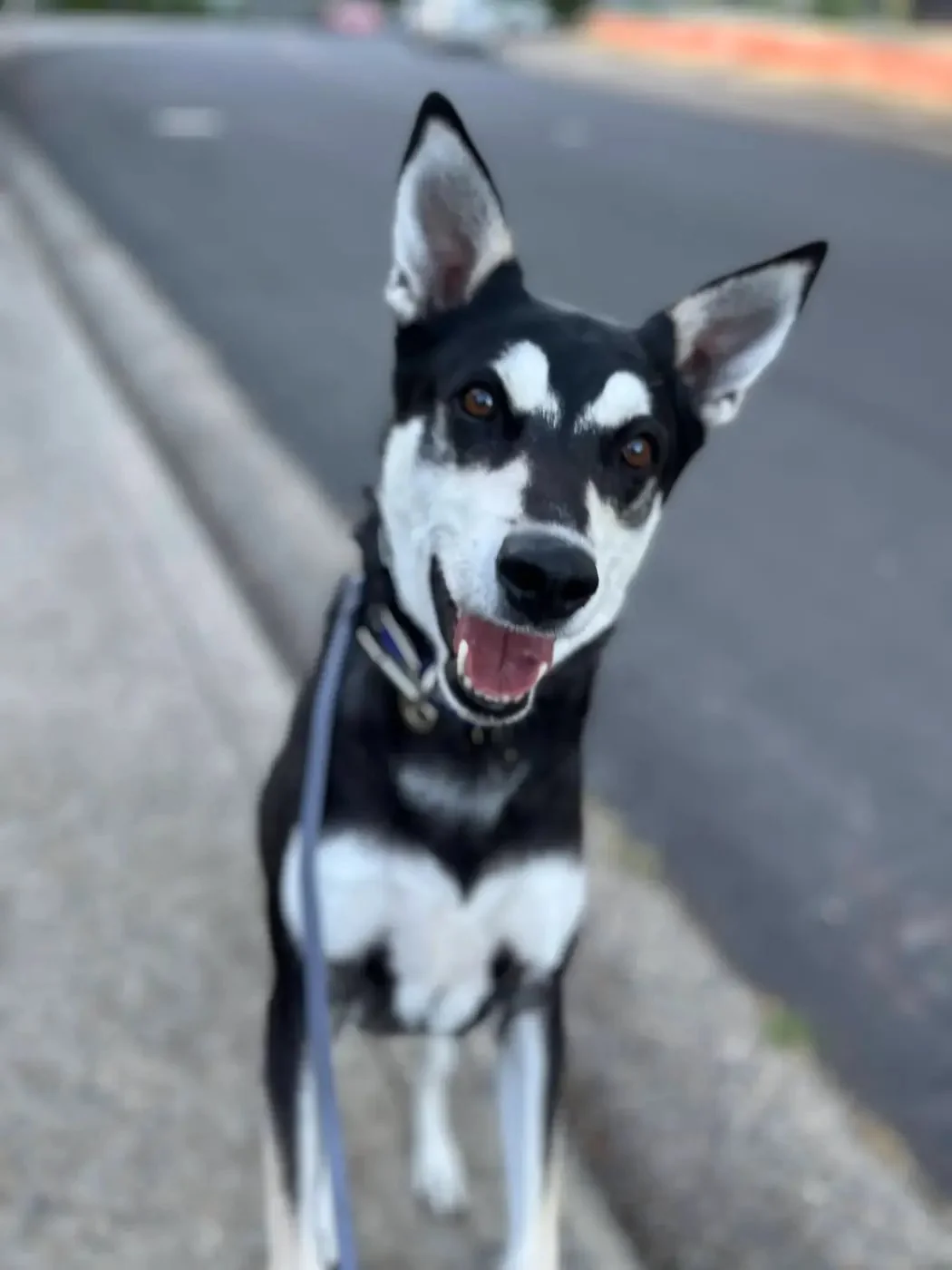
Make-Right Guarantee
The Make-Right Guarantee: if we have not hit your goals after the 6 sessions of E.D.G.E., you get up to 4 additional lessons at no cost, bringing it to 10 lessons. At least one of those is mine alone, with no leash in your hand.
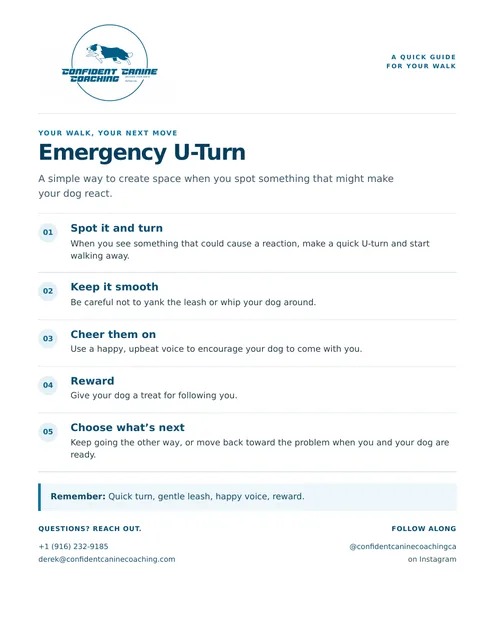
Free one-page cheat sheet
Not ready to book? Start here.
Get the Emergency U-Turn Cheat Sheet: a simple way to create space on a walk when you spot something that might make your dog react.